AI vs SI vs NI: Understanding the Three Pillars of Modern Intelligence
The world of technology is rapidly moving beyond traditional computing. We’re entering an era where machines don’t just process the instructions — they learn, evolve, and think. Let’s see how these three forms relate to one another and their significance for our future.
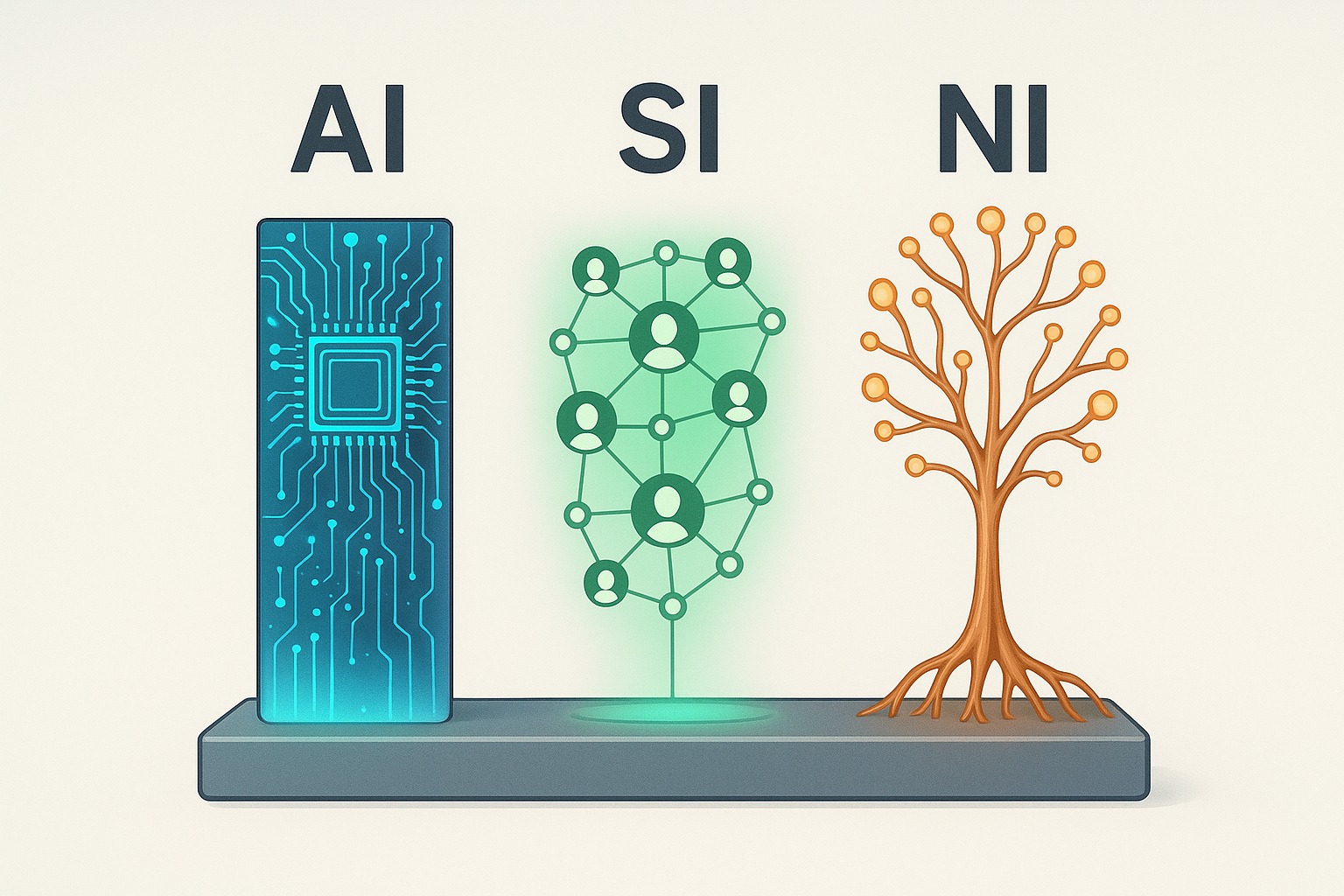
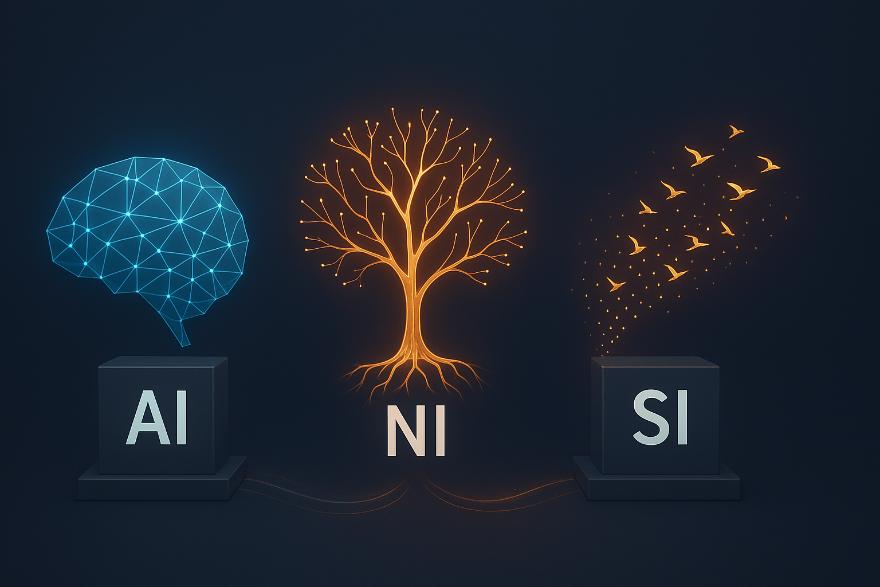
Artificial Intelligence (AI) has become an ubiquitous term, shaping our daily experiences through smart assistants, autonomous vehicles, and data-driven tools. Meanwhile, Synthetic Intelligence (SI) — a more futuristic concept — explores how machines could develop independent cognition. But before we compare these man-made systems, it’s essential to remember the foundation of it all: Natural Intelligence (NI), the biological intelligence that defines human and animal thought. These three forms together show how intelligence has evolved, from nature to machines, and now moving beyond possibilities.
Understanding Natural Intelligence (NI)
Natural Intelligence is what makes us humans apart, our ability to think, reason, create and adapt to the constant changes in the world around us. It is the result of millions of years of evolution, accrued and shaped not just by code or logic, but also by emotion, memory and experience. Unlike machines, which depend on strict programming, NI depends on conscious awareness, creativity, moral reasoning, and emotional understanding —those elements that give depth and meaning to thought. Natural Intelligence is inherent in every human being. When one aligns with it, one remains centered — undisturbed by challenges and free from feverishness or agitation.
Assume a child is learning to ride a bicycle. At first, they struggle to hold, stumble, fall, and get back up again. Yet over time, their brain gets adjusted to the balancing, steering, and eventually, it reacts instinctively without consciously thinking about every movement. The child might pedal faster when it’s dark or slow down near a puddle, not because anyone told them to, but because experience has shaped that decision. This is the beauty of Natural Intelligence — learning not from instruction but from understanding, emotion, intuition and experience.
Human NI allows for:
- Spontaneous decision-making
- Emotional connection and empathy
- Abstract and creative thinking
- Moral and ethical reasoning
In essence, NI represents the original blueprint for all other forms of intelligence. It is flexible, self-aware, and capable of genuine understanding — something AI and SI are still striving to achieve. Projects like Intel’s Loihi and IBM’s TrueNorth are perfect examples of how biological intelligence inspires hardware innovation.
Artificial Intelligence (AI): The Digital Mind We Built
Artificial Intelligence is the design of those systems that can perform tasks requiring human-like abilities — such as perception, reasoning, or communication. The keyword here is artificial: AI doesn’t possess awareness; it just follows learned patterns from the data to simulate understanding. Artificial Intelligence represents the bridge between human thinking and machine processing. From our phones to research labs, AI shows up everywhere.
Common examples include:
- Chatbots and virtual assistants
- Recommendation systems (Netflix, YouTube)
- Facial recognition and speech translation tools
- Predictive models in healthcare or finance
Think of your smartphone’s voice assistant. Ask it to play your favourite song, and it does. Tell it to remind you to call someone, and it remembers. It recognises your words, understands commands, and responds almost instantly. But if you say something outside its programming — maybe a joke or a deeply emotional story — it doesn’t really get it. That’s Artificial Intelligence in action, a system trained to follow patterns and instructions, powerful yet unaware of what it truly does.
AI’s main strength lies in efficiency and accuracy, not consciousness. It’s brilliant at automating tasks but lacks emotional depth, self-awareness, and creativity in the human sense. Projects like OpenAI’s ChatGPT, DeepSeek and Google DeepMind’s AlphaFold demonstrate how artificial systems can handle huge datasets and uncover insights beyond human reach.
Synthetic Intelligence (SI): The Emerging Frontier
Synthetic Intelligence is an evolving concept that goes beyond imitation. Instead of mimicking human thinking, SI aims to create a new type of intelligence — one that can grow, evolve, and generate its own understanding of the world.
SI represents a step toward machines that can:
- Learn independently without human input
- Develop emotions or ethical reasoning frameworks
- Evolve through experience rather than code
For example, picture a home robot of the future — not just one that cleans or takes orders, but the one that notices and responds appropriately as a human does. It sees you’re tired after work, dims the lights, adjusts the temperature, and quietly brews coffee — not because someone told it what to do, but because it learned to recognize your behaviour over time. It adapts, evolves, and even changes its own routines as your habits shift. This is what we call Synthetic Intelligence — an intelligence that isn’t just taught, but that teaches itself. It understands context, makes choices, and grows on its own.
While still mostly theoretical, SI challenges the limits of what machines can become. It envisions systems that are programmed not just to act intelligently but designed to be intelligent, perhaps even more conscious.
Comparing NI, AI, and SI

These three aren’t competitors — they’re collaborators in the story of intelligence. Each represents a different layer of understanding, from the biological to the digital to the synthetic. Together, they form a bridge between what nature created and what technology is striving to become.
A Thought to Ponder
The relationship between NI, AI, and SI raises deep philosophical and ethical questions. If machines one day develop true synthetic intelligence, would they possess consciousness or moral responsibility? And if they did gain consciousness, how would that redefine what it means to be alive or intelligent?
Natural Intelligence reminds us of the emotional and moral dimensions of thinking. Artificial Intelligence shows how far we can go in replicating those traits. Synthetic Intelligence dares to imagine a world where machines might transcend imitation and achieve genuine cognition.
The Road Ahead
As AI continues to shape industries and daily life, and SI progresses from theory to experiment, NI remains the benchmark — the standard by which all forms of intelligence are measured. Future breakthroughs may blur the lines between these domains, designing hybrid systems that blend biological intuition with computational precision. The coming era may not just be about smarter machines, but about redefining what intelligence itself means in a world where human and synthetic minds coexist.
Conclusion
- Natural Intelligence represents the origin of thought.
- Artificial Intelligence embodies our attempt to replicate it.
- Synthetic Intelligence envisions the next evolution — where we’re headed — towards systems that might one day think, learn, and create on their own. The intelligence that could exist without us.
As we move deeper into this age of intelligent design, one thing appears to be distinctly clear: the future of technology won’t just be about faster processors or smarter algorithms — it will be about understanding what it truly means to think.
Written by
Priyanka C
Application Engineer
Ramaiah Academy